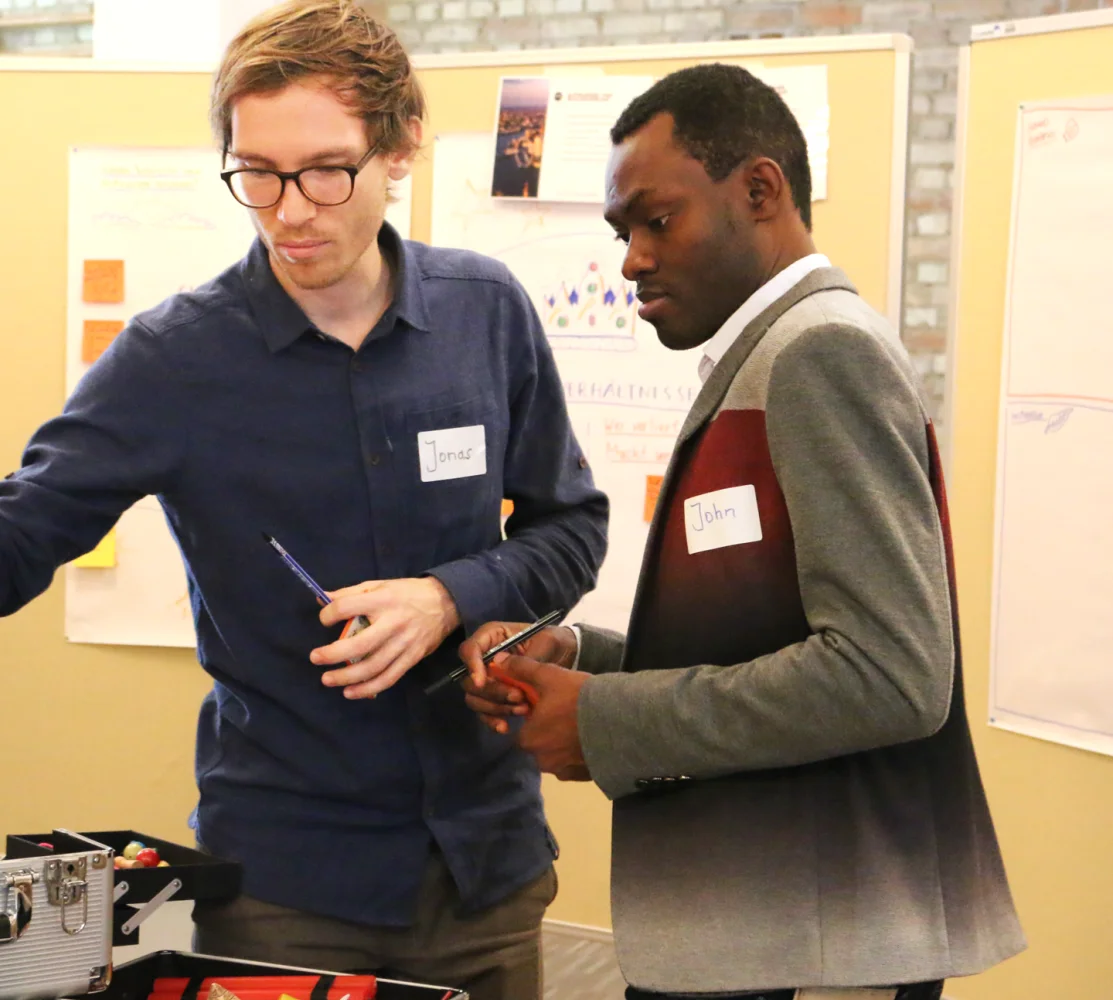
An initial idea, a research finding or an observation that might lead to something more: this is where startup support begins. In this interview, Bert-Morten Arnicke, Stefi Zillessen and Edgar-John Vogt (from left) talk about how they support students and researchers, why experimenting plays a key role in the process, and what they enjoy about working with people interested in starting a business.
Stefi: Besides the variety of startup ideas, what I enjoy most is working directly with aspiring founders and interacting with them on equal terms. Being able to closely follow the development of future entrepreneurs and their business ideas is something I really value – and it’s a lot of fun, too. :)
Bert: What fascinates me most are the people behind the ideas – their personalities and what motivates them to turn their ideas into reality. Every founder starts from a different point, and what they expect from us as startup advisors varies just as much. Young founders often come to us with an interesting observation, a research finding or simply the feeling: “There must be more we can do with this.” Exploring its potential together and working out the first steps is what I find particularly exciting about our work.
Stefi: It really varies: some have questions about funding, others want to talk through an initial idea or are looking for people to join their team. Whatever your question is, you can come and talk to us.
Bert: Funding is actually one of the topics that comes up quite often - especially how to find the right funding programme and apply for it. But our support goes well beyond that. We look at the idea together: Is it relevant? Could it work as a business? We also help people make the right connections, for example with potential customers or co-founders. And, of course, we help with funding applications too.

Bert: Many people are surprised by how straightforward that first conversation actually is. We mostly listen. We want to understand where the idea comes from, what problem it solves and what motivates the person behind it. Together, we look at what makes sense to do next – whether that means testing the idea, talking to potential customers, exploring funding opportunities or building a team.
For me, it’s especially important to take some of the pressure off. Starting a business is a process, not a sprint. No one needs to have all the answers at the first meeting. That’s exactly what we’re here for: to ask the right questions together, explore different options and help you find your direction.
Stefi: As a sparring partner for whatever comes up along the way.
Bert: I see myself as a motivator and someone who is there to support people along the way. I want to help turn an idea into a viable business model – by asking the right questions, offering new perspectives and bringing in my experience and network. What I especially enjoy is seeing an initial idea grow into a business that makes innovation from MLU more visible in Halle and the wider region.
Edgar: Yes - but perhaps not quite in the same way you learn maths or a foreign language. You learn entrepreneurship by doing it. Of course, there are methods and tools we can teach: How do I identify a relevant problem? How do I understand my target group? How do I develop and test a solution? And how can I turn it into a viable business model?
For me, entrepreneurship education goes beyond that. It is also about developing an entrepreneurial mindset: being curious, recognising opportunities, dealing with uncertainty, taking responsibility, making decisions and having the courage to actually try out your own ideas.
That’s exactly why I think it’s important to give students space to experiment: without expecting every idea to turn into a startup. Once you’ve experienced how a problem can lead to initial ideas, conversations with potential users and tests, and eventually to a concrete solution, you take away something that goes far beyond starting a business.
Edgar: I see great potential in international students and researchers for our startup ecosystem. They bring new perspectives and different experiences, and often ideas that emerge from challenges in their home countries or from international markets.
At the same time, starting a business in another country comes with its own challenges. It’s not just about the business idea. You also need to understand: How does the German startup ecosystem work? What legal requirements do I need to know about? Where can I find support and funding? And most importantly: Who can I turn to?
This is exactly where MLU’s International Startup Office comes in. We want to make entrepreneurship more accessible to international students and researchers – through workshops and training in English, initial guidance, and connections to our Transfer and Startup Service and the regional startup ecosystem.
Stefi: I founded my own company - a limited liability company in the pet food sector - and ran it as managing director for more than five years. So I experienced all stages of starting and building a business myself, from the first vague idea to profitable growth. But even beyond that, I would say that an entrepreneurial approach has always shaped the way I work.
Bert: Working for agencies and startups, I learned early on to look at my work from an entrepreneurial perspective. I also work as a musician alongside my main job, which means taking initiative myself - finding new gigs, dealing with clients and taking care of all the administrative side of things.

Stefi: The best way to find out is to give it a try. And as your startup support team, we’re here to help with advice and practical support along the way.
Bert: Use our experience to try out and test your ideas. Let’s take the first steps together!
Have an idea of your own and want to find out where it could lead? Learn more about our startup support and arrange an initial meeting.